

Benefits of Training With Bodybuilding Equipment Explained
Last Updated: November 6, 2026
Quick Summary
Bodybuilding equipment helps you build muscle size and strength by controlling how each muscle is loaded. Machines isolate specific muscle groups and offer a stable path that suits beginners, while free weights build more total-body strength. Most lifters get the best results by combining both.
- Machines isolate specific muscles and offer a stable path of motion, which makes them easier for beginners to learn.
- Free weights demand more stabilizer muscle activity and build more total-body strength.
- Adjust the seat and pad so the joint lines up with the machine's pivot point before your first set.
- Use double progression: stay at a weight until you hit the top of the rep range, then add the smallest load increment.
- Fixed machine paths may not fit every body, so a machine that binds at the joint should be swapped out.
Table of Contents
- What Bodybuilding Equipment Covers and Why It Matters
- Muscle Isolation and Targeting Specific Muscle Groups
- Machines vs Free Weights for Hypertrophy
- Machines or Free Weights for Beginners: Stability, Safety and Setup
- Machines vs Free Weights for Strength and Progressive Overload
- Free Weights vs Machines: Pros, Cons and Limitations
- Building a Sample Machine-Based Routine and Progressing Over Time
- Booking Your First Session at Pros Gym
- Frequently Asked Questions
What Bodybuilding Equipment Covers and Why It Matters
Bodybuilding equipment is the broad category of machines, racks, benches and free weights used to build muscle size and strength. The equipment matters because the right tool makes it easier to load a muscle safely and progressively.
Here is what the category usually includes:
- Weight machines (chest press, leg press, lat pulldown, leg curl)
- Plate-loaded and selectorized equipment
- Squat racks, benches and power racks
- Free weights such as dumbbells, barbells and kettlebells
- Cable stations for controlled, continuous tension
The core benefit is control. Each tool guides your body in a different way, and knowing those differences helps you pick the best option for your goals.
Muscle Isolation and Targeting Specific Muscle Groups
Machines are designed to isolate specific muscle groups. A leg extension, for example, works the quadriceps with little help from other muscles. This makes it easier to target a lagging area without fatiguing the whole body first.
Isolation helps in three practical ways:
- It lets you focus effort on one muscle at a time
- It reduces the chance that a weaker muscle limits the set
- It gives beginners an easier way to learn which muscle they are working
Watch out: isolation work alone will not build full-body strength. Pair machines with compound lifts for balanced results.
Machines vs Free Weights for Hypertrophy
Hypertrophy is the scientific term for muscle growth (ncbi.nlm.nih.gov). Both machines and free weights can drive it when sets are taken close to failure and load increases over time. The difference is mostly in how the work is distributed.
Free weights demand more stabilizer muscle activity. Machines let you push a single muscle harder with less balance demand. Many lifters combine both, using free weights for heavy compound work and machines for extra volume on specific muscles.
Machines or Free Weights for Beginners: Stability, Safety and Setup
Machines are often the easier starting point for new lifters. The fixed path of motion guides your body, so you spend less effort balancing. That stability helps you learn the movement pattern before adding more load.
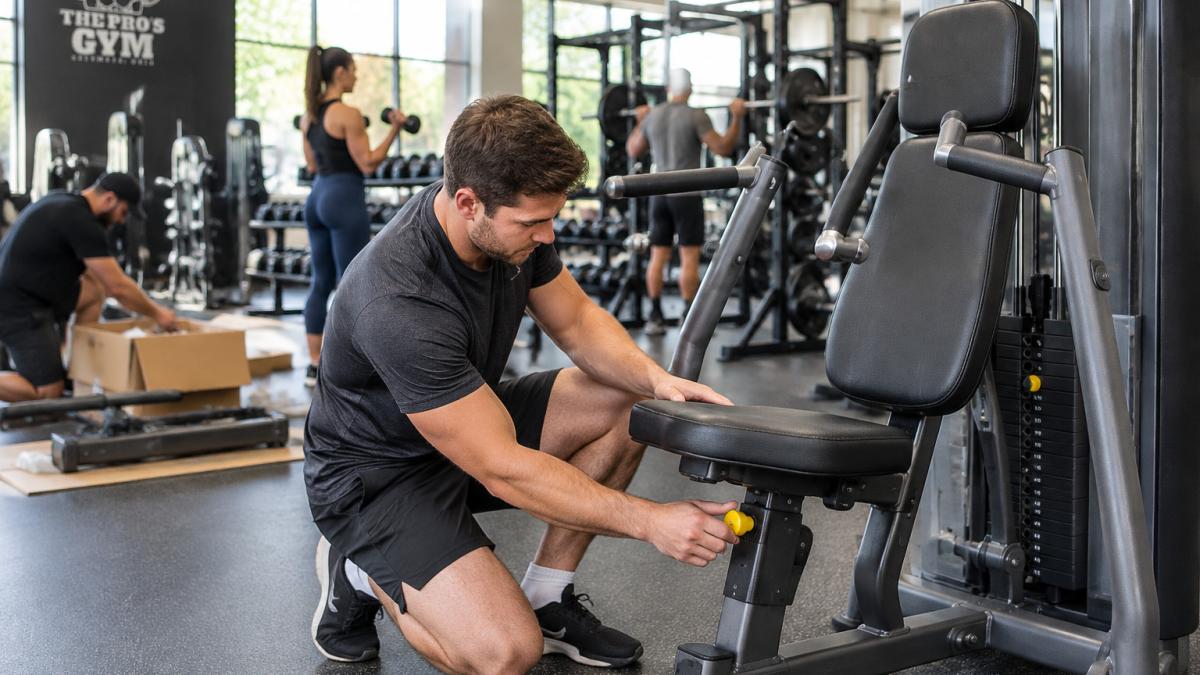
Setup matters just as much as the choice. Before your first set on any machine:
- Adjust the seat or pad so the joint lines up with the machine's pivot point
- Choose a weight you can lift with control for 10 to 12 reps
- Brace your core and keep your back flat against the pad
- Move through a full, controlled range without bouncing the weight
Free weights are also a fine beginner choice when you learn with light loads and a spotter. Ask a staff member at Pros Gym to show you proper form before you lift heavy.
Machines vs Free Weights for Strength and Progressive Overload
Strength depends on lifting heavier loads over time. This principle is called progressive overload. Free weights and barbell lifts tend to build more total-body strength, because they demand balance and force from many muscles at once.
Machines still help strength. They let you safely push a muscle to a heavy load without needing a spotter. Use them for accessory work that supports your main lifts. Track your loads each week, and add a small amount of weight when you hit your target reps with good form.
Free Weights vs Machines: Pros, Cons and Limitations
Each option has clear strengths and drawbacks. The useful question is not which is better but which fits your goal, experience, and body. Use this guide to weigh them:
| Option | Pros | Cons | Best For |
|---|---|---|---|
| Machines | Stable path, easy setup, good isolation, safe to push close to failure without a spotter | Less balance and stabilizer work, fixed range that may not match your joints | Beginners, isolation, high-volume accessory work, training alone |
| Free weights | Full-body strength, flexible movement, strong carryover to daily tasks and sport | Harder to learn, needs spotters for heavy sets, form breaks down under fatigue | Strength goals, athletic carryover, compound lifts |
| Cables | Constant tension through the range, smooth resistance, joint-friendly | Lighter maximum loads, setup takes a moment | Accessory work, isolation with tension at end range |
Limitations of machines: fixed movement paths are built around an average body, so seat height, pad position, and handle width may not line up with your limb lengths. A machine that fits poorly can push your joints into an awkward path and load tissue unevenly. Machines also do less for stabilizer muscles, so a program built only on machines can leave you strong in the machine and less capable under free load. Overreliance on machines can also hide strength imbalances, because the stronger side can quietly take over.
Limitations of free weights: form slips when fatigue sets in, heavy sets need a spotter or safety pins, and beginners often spend early sessions learning balance instead of loading muscle.
How to decide by goal:
- For hypertrophy, use machines and cables for isolation volume and free weights for compound lifts.
- For strength, anchor your week with free-weight compounds and use machines for accessory work.
- For general fitness or returning from injury, start with machines to rebuild tolerance, then add light free weights.
- For older adults, machines offer a controlled way to load muscle with less balance demand, and free weights can be added as confidence grows.
Watch out: a machine that feels wrong at the joint is not a form problem you can fix by pushing harder. Adjust the seat and pad first, and if it still binds, choose a different machine or a free-weight variation.
Building a Sample Machine-Based Routine and Progressing Over Time
A machine-based routine works best when it follows a repeatable structure: warm up, train large muscle groups before small ones, and finish with isolation work. The sample below is a three-day full-body plan that alternates emphasis across sessions.
Day A (push emphasis)
- Leg press: 3 sets of 8 to 12 reps
- Seated chest press: 3 sets of 8 to 12 reps
- Shoulder press machine: 2 sets of 10 to 12 reps
- Cable triceps pressdown: 2 sets of 12 to 15 reps
Day B (pull emphasis)
- Lat pulldown: 3 sets of 8 to 12 reps
- Cable row: 3 sets of 8 to 12 reps
- Leg curl: 2 sets of 12 to 15 reps
- Cable curl: 2 sets of 12 to 15 reps
Day C (mixed)
- Leg press: 3 sets of 10 to 12 reps
- Chest press: 2 sets of 10 to 12 reps
- Lat pulldown: 2 sets of 10 to 12 reps
- Leg extension: 2 sets of 12 to 15 reps
- Shoulder press machine: 2 sets of 10 to 12 reps
Start each session with 5 to 10 minutes of light cardio and one warm-up set per exercise at about half your working load. Rest 60 to 90 seconds between sets on isolation work and 90 to 120 seconds on leg press and chest press. Train on nonconsecutive days, such as Monday, Wednesday, and Friday.
How to choose your starting load: pick a weight you can lift for the bottom of the rep range with two reps still in reserve. If you cannot complete the bottom number with clean form, drop one plate or one pin setting. If you finish the top of the range easily on every set, you are ready to add load.
How to progress: use double progression. Stay at the same weight until you hit the top of the rep range on all sets, then increase the load by the smallest increment the machine allows, usually one pin on a selectorized stack or one pair of small plates on a plate-loaded unit. Drop back to the bottom of the rep range and build up again.
How to track it: log the date, exercise, load, sets, reps, and a simple form note for each session. A notebook or phone note is enough. Review the log every four to six weeks. If a lift has not moved in three sessions and sleep and food are consistent, change the exercise variation or add one set rather than forcing more weight.
Watch out: adding weight before you own the top of the rep range is the most common cause of stalled progress and nagging joint pain on machines.
Booking Your First Session at Pros Gym
Ready to start? Pros Gym offers 24-hour access, three full floors of new and classic equipment, and professional personal training for powerlifting and bodybuilding. Visitors can check current training pass options before buying, and membership and guest pass choices are laid out clearly so you can compare them. If you want guided help with setup and form, personal training for powerlifting is worth a look. For a full beginner program with progression guidance, our 8-week strength plan covers exercise picks and recovery. And if you want to check equipment quality before you lift, our hands-on equipment checklist walks you through frame steel, welds and load ratings.
Frequently Asked Questions
Can you build muscle using only gym machines?
Yes, machines can build muscle when training is hard enough and progressive. Machines guide the movement path and make it easier to load a target muscle safely, which supports hypertrophy. Free weights add balance and coordination demands that machines do not, so many lifters combine both. Track your sets, reps and loads each week and add weight or reps over time. Pros Gym offers machines and free weights across its three floors, and current membership options are listed on its website.
Are machines or free weights better for beginners?
Machines are often the easier starting point because the seat, pad and handles set the path of motion, which reduces the balance and setup work a new lifter must manage. This helps beginners learn the target muscle's role in each exercise. Free weights become valuable as strength and coordination improve. A practical approach is to start with machines for two to three months, then add basic free weight lifts under supervision. Ask staff at Pros Gym about help with equipment setup.
Are gym machines effective for bodybuilding?
Gym machines are effective for bodybuilding when used with progressive overload, adequate training volume and sufficient recovery. They allow controlled isolation of muscle groups and let you train close to failure with less risk than some free weight lifts. Limitations include fixed movement paths that may not match every body's joint alignment, and less demand on stabilizing muscles. Most successful bodybuilding programs use a mix of machines and free weights matched to specific goals.
How many hours a day does a bodybuilder train?
Most bodybuilders train about one to two hours per session, typically four to six days per week, with rest days built in for recovery. Total training time depends on experience, goals and recovery capacity rather than a fixed daily number. Training longer does not automatically produce more muscle, and fatigue can reduce quality. Consistent, well-structured sessions with progressive loading matter more than hours logged. Pros Gym's 24-hour access lets members schedule sessions around work and school.
