

Which Powerlifting Hoodie Is Best for Training?
Last Updated: November 12, 2026
Quick Summary
The best powerlifting hoodies have heavier fabric, roughly 9 to 10 ounces per square yard, with stretch in the cuffs and hem so they stay put during squats, bench presses and deadlifts. Choose a zip-up for adjustable warmth between sets or a pullover for fewer snag points and steady chest coverage.
- Look for heavier fabric, such as 9-ounce fleece or 10 oz./yd² blends, that holds its shape between sets.
- Choose cuffs and hems with spandex or rib-knit stretch so the fabric does not ride up over your belt.
- Zip-ups offer adjustable warmth, while pullovers have fewer snag points for heavy sessions.
- Measure a well-fitting hoodie you own and compare it to the size chart, since lifters often need to size differently.
- Rotate two or three hoodies and replace them once the ribbing loses its stretch.
Table of Contents
- What Makes a Powerlifting Hoodie Different From a Regular Hoodie
- Fabric Weight and Material: Why 10 oz. Cotton-Poly Blends Stand Out
- Fit, Range of Motion and Sizing for Squats, Bench Press and Deadlifts
- Warmth and Between-Set Coverage: Layering Choices for the Gym Floor
- Pullover vs. Zip-Up: Practical Features That Affect Your Training
- Side-by-Side Comparison of Pros Gym Hoodies, Including Pricing
- Caring for Your Hoodie So It Lasts Through Heavy Training
- Choosing Your Hoodie and Getting Sized Before Your Next Session
- Frequently Asked Questions
What Makes a Powerlifting Hoodie Different From a Regular Hoodie
Most people assume a hoodie is a hoodie. In the gym, that assumption costs you. A powerlifting hoodie is built for heavy squats, bench presses and deadlifts, not just for walking in from the parking lot. The difference shows up in the fabric weight, the cut, the hood and the cuffs, and in how the garment behaves under a loaded bar. (Source: Federal Trade Commission's labeling requirements)
Start with weight. A standard fashion hoodie feels thin and bunches when you bend. A training hoodie uses heavier cotton or fleece, so it holds its shape between sets. Stretch matters too: look for a poly-filament cross-stretch fabric or a little spandex in the cuffs and waistband, because a rigid hem rides up when you drop into a squat.
The Pro's Gym Zip-Up Hoodie is made from 9-ounce fleece (305 GSM) and uses an 80/20 combed ring-spun cotton/poly blend, with metal-tipped drawcords and rib-knit cuffs and hem. The Pro's Gym Hoodie range uses a 10 oz./yd² blend with double-needle stitching.
Fabric Weight and Material: Why 10 oz. Cotton-Poly Blends Stand Out
Fabric weight is the first spec to check when shopping for powerlifting hoodies. Hoodies are often described in ounces per square yard, and the heavier end of the range holds up better to frequent training. Pros Gym's Hoodie range uses 10 oz./yd² material, while the Zip-Up Hoodie uses 9-ounce fleece (305 GSM).
Material blend matters as much as weight. An 80/20 cotton-polyester mix keeps the softness of cotton while the polyester adds durability and helps the garment keep its shape after many washes. A 100% cotton face, as used on the Zip-Up Hoodie, feels smooth against the skin. Choose the blend based on whether comfort or dry time matters more to you.
Watch out: heavier fabric is warmer, which is a benefit between sets but a drawback in a hot gym. If you train in a warm facility, a mid-weight option may keep you more comfortable through the full session.
Fit, Range of Motion and Sizing for Squats, Bench Press and Deadlifts
Fit is where a training hoodie either earns its place or gets in the way. A hoodie that feels fine in front of a mirror can bunch at the waist when you brace for a squat, ride up over your belt when you set up for a deadlift, or pull across the upper back when you retract your shoulder blades on the bench.
Squat bracing. When you brace against a belt, the fabric across your midsection and lower back has to stay put. A rigid rib-knit hem tends to ride up over the belt as you descend, leaving a gap at the waist that lets cold air in and can catch on the buckle. A hem with a little spandex, or a slightly longer body, keeps the fabric anchored.
Bench setup. The bench press punishes tight shoulders and short sleeves. A hoodie that is snug across the upper back restricts scapular retraction, and a sleeve that binds at the armpit pulls when you set your arch and grip the bar. Look for a shoulder seam that sits slightly off the point of the shoulder and a sleeve that lets you reach forward and up without tugging across the chest.
Deadlift setup. The deadlift is mostly a hip-hinge problem for a hoodie. Excess fabric at the front hem folds under when you hinge to the bar, and a bulky hood can flop into your line of sight as you set your back. A trimmer body and a hood that lies flat against the upper back keep the setup clean.
Sizing for lifting builds. Standard size charts are built for general apparel, not for lifters with broad shoulders, thick upper backs and comparatively narrow waists. Measure a hoodie you already own that fits well across the chest and compare that number to the chart rather than trusting your usual size. The Pro's Gym Premium Hooded Sweatshirt lists chest width and length by size in its size guide.
Roominess by preference. Lifters who want the hoodie to move independently of the bar generally prefer a roomier body with a defined shoulder. Lifters who use it as a warm-up layer over a singlet often want a closer fit that does not add bulk under a belt. Decide which role the hoodie plays before you order, because the same size will feel different in each case.
Warmth and Between-Set Coverage: Layering Choices for the Gym Floor
Between sets, your body cools quickly. A heavy hoodie can keep your shoulders and arms warm while you rest, which supports better performance on the next working set. A zip-up has a practical advantage here, since you can open or close it without pulling it over your head with a loaded bar nearby.
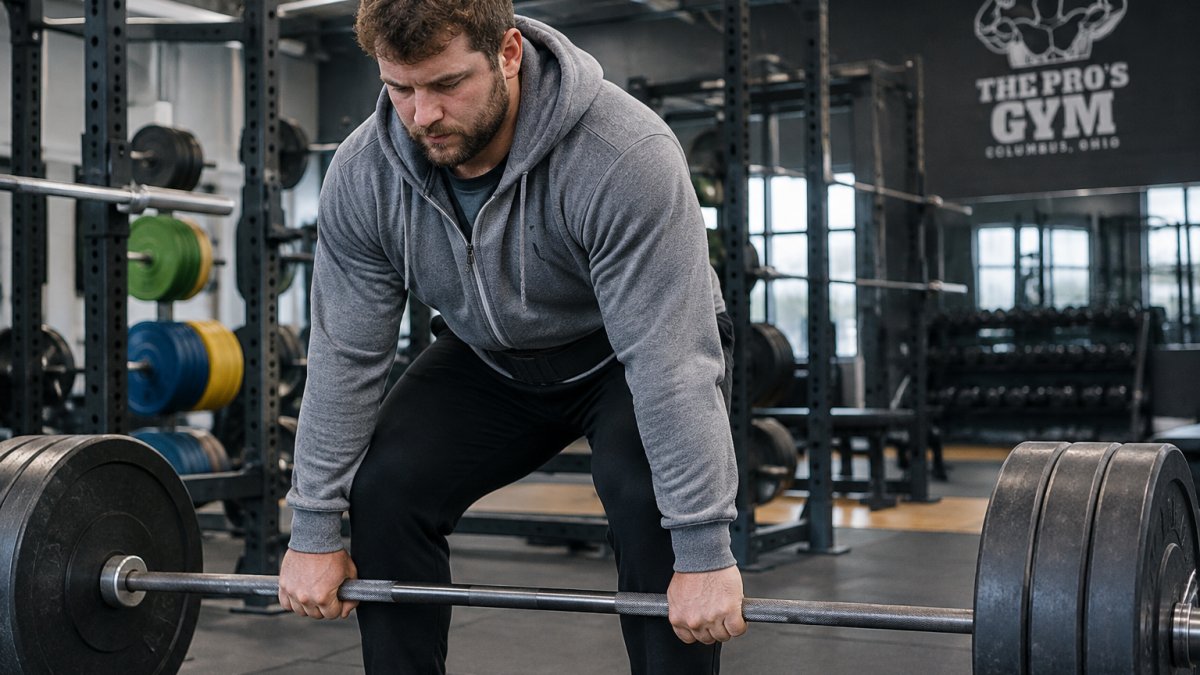
Layering works best when the hoodie is the outer piece over a lightweight base. In colder months, a fleece zip-up over a fitted shirt gives you adjustable warmth. In warmer months, a single midweight pullover is usually enough. The Pro's Gym New Logo Pullover Hoodie and the Zip-Up Hoodie cover both approaches, so you can match the layer to the season and the facility temperature.
Pullover vs. Zip-Up: Practical Features That Affect Your Training
The pullover-versus-zip-up decision is usually framed as a warmth question, but for powerlifting the more useful frame is interference. Every feature, from the hood to the pocket and the drawcord, can either stay out of the way of a belt, a bar or a bench or become a nuisance at the worst moment.
Hood bulk. A hood that stands up stiffly or holds a lot of fabric will flop forward when you hinge for a deadlift or lie back on a bench, blocking your view of the bar or pressing into the bench pad. Pullovers and zip-ups can both have bulky hoods, so judge the hood on its own. (Source: National Institute for Occupational Safety and Health guidelines)
Drawstrings and cord tips. Loose drawstrings are the most common snag risk on a training hoodie. Metal-tipped drawcords hold their shape and are less likely to fray, but a long cord can swing into your face during a set or catch under a bar. Tuck the cords inside the hood or knot them short before you lift.
Pockets. A kangaroo pocket is convenient between sets but adds a double layer of fabric across the belly, which can bunch under a belt and interfere with bracing. If you wear a belt for squats and deadlifts, a flatter pocket or no front pocket keeps the waist cleaner.
Cuffs and hem. Rib-knit cuffs that hold their stretch keep the sleeves from sliding down over your hands during a bench press, and a hem with a little spandex keeps the body from riding up over a belt. Pull the cuffs over your hands and let go; a cuff that stays put is doing its job.
Zipper versus no zipper. A zipper adds a seam and a metal pull that can press against a bench or catch on a belt, but it gives you adjustable ventilation without pulling the hoodie over your head between sets.
How to decide. If you train in a facility with variable temperatures and want to open the hoodie during warm-ups, a zip-up with side pockets and a flat hood is the more practical choice. If you want the fewest snag points and the warmest chest coverage for heavy sessions, a pullover with a trim pocket and a hem that stays below your belt line is the better fit.
Side-by-Side Comparison of Pros Gym Hoodies, Including Pricing
The table below compares the Pro's Gym hoodies on the points that matter most for training. Prices are current starting prices in USD.
| Hoodie | Style | Starting Price | Best For |
|---|---|---|---|
| Zip-Up Hoodie (Premium Athletic Fleece) | Zip-up | $29.99 | Adjustable warmth between sets |
| Premium Zip-Up Hoodie | Zip-up | $27.99 | Budget-conscious zip-up buyers |
| New Logo Pullover Hoodie (Columbus Edition) | Pullover | $34.99 | Heavy sessions and everyday wear |
| Retro Logo, Bold Back Design | Pullover | $29.99 | Pullover without a zipper |
| Classic Collection | Pullover | $29.99 | Versatile daily training |
| Big Front Print Design | Pullover | $39.99 | Lifters who want bold graphics |
| Power Pose Design | Pullover | $39.99 | Heavy, warm training layers |
| Premium Hooded Sweatshirt | Pullover | $27.99 | Lowest-cost pullover option |
Starting Price
Pros and cons at a glance:
- Zip-Up Hoodie (Premium Athletic Fleece), $29.99. Pro: adjustable warmth and a 100% cotton face. Con: heavier and warmer in hot rooms.
- Premium Zip-Up Hoodie, $27.99. Pro: lowest zip-up price. Con: same fleece weight, so less room for warm-weather use.
- New Logo Pullover Hoodie, $34.99. Pro: slight stretch and a spacious pocket. Con: the highest starting price on this list.
- Classic Collection, $29.99. Pro: reinforced double-needle stitching. Con: no zipper for ventilation.
Best for: lifters who want one reliable pullover for gym and everyday wear. Skip if: you train in a very warm facility and need light, quick-dry fabric.
Caring for Your Hoodie So It Lasts Through Heavy Training
Heavy training puts repeated stress on seams, cuffs and fabric. Wash the hoodie inside out in cold water to protect the print and reduce pilling. Avoid high heat in the dryer, since heat is the main cause of shrinkage in cotton-poly blends. Air drying keeps the fit consistent and extends the life of the spandex in the cuffs and waistband.
Rotate two or three hoodies if you train several days a week; giving each one a rest between sessions helps it recover its shape and reduces wear. Check drawcords and cuffs every few weeks, and replace a hoodie once the ribbing loses its stretch, because a loose cuff stops holding the fabric in place during lifts.
Choosing Your Hoodie and Getting Sized Before Your Next Session
Start with three questions: how warm your gym runs, whether you prefer a zip-up or pullover, and how often you train. A zip-up suits variable temperatures and frequent adjustment. A heavyweight pullover suits steady warmth and simple wear. Check the size chart, measure a hoodie that already fits you, and match the numbers before ordering.
Browse the full range at Pros Gym's hoodie collection and compare the zip-up option against the classic pullover. If you want the pullover with the updated Columbus logo, the New Logo Pullover is the one to view.
Come train like a pro at Pros Gym. Choose a hoodie that fits your lifts, check the size chart, and order before your next session.
Frequently Asked Questions
What is the best hoodie for training?
For heavy squat, bench press and deadlift sessions, look for a heavyweight cotton-poly blend around 10 oz. per square yard, a relaxed but not baggy fit that does not catch on the bar, and a front pocket for chalk-free essentials. Pros Gym's Pro's Gym New Logo Pullover Hoodie - Columbus Edition ($34.99) and Pro's Gym Hoodie - The Classic Collection ($29.99) both use a 10 oz. construction with double-needle stitching.
Is it good to lift weights in a hoodie?
Lifting in a hoodie is practical as long as it does not restrict your movement. A hoodie with stretch in the fabric and ribbed cuffs keeps sleeves from sliding into your grip during a bench press or deadlift. Keep the hood down during heavy lifts so it does not interfere with your head position or your view of the bar.
What should you look for in a powerlifting hoodie?
Focus on fabric weight, fit and construction. A 10 oz. per square yard blend is the fabric weight listed for Pros Gym's Hoodie range, and the poly-filament cross-stretch fabric is listed in the product specs. Check for reinforced double-needle stitching, a jersey-lined hood, and ribbed waistband and cuffs with spandex. Size by chest width and length rather than by label, since the Pro's Gym Premium Hooded Sweatshirt lists specific chest and length measurements for each size from S to 3XL.
