

Columbus Personal Training: How to Choose a Trainer and Program
Last Updated: November 19, 2026
Quick Summary
Columbus personal training is one-on-one or small-group coaching built around your goals, schedule, and starting point, with the local market split between big-box gyms that treat training as an add-on and facilities that build programs around the individual lifter. The format you pick matters more than the trainer's personality, so ask how many clients a trainer coaches at once before you sign.
- One-on-one training offers the highest attention and suits beginners, technique work, and injury history.
- Ask how many clients a trainer coaches at once; more than six means group fitness with a personal training label.
- Compare quotes on per-session rate, expiration terms, membership bundling, and assessment fees.
- Beginners should spend the first four weeks learning the squat, hinge, push, pull, and carry patterns.
- Verify a trainer's certification with the issuing organization and confirm current CPR and first aid training.
Table of Contents
- What Columbus Personal Training Actually Looks Like
- Quick Comparison: Personal Training Options and Pricing
- Columbus Personal Training Prices: What Drives the Cost
- Columbus Personal Training Membership Cost and Package Terms
- Strength Training for Beginners: Your First Four Weeks
- Personal Training for Athletes: Speed, Agility, and Sport-Specific Work
- How to Evaluate Trainer Credentials, Safety, and Fit
- Book Your First Session at Pros Gym
- Frequently Asked Questions
What Columbus Personal Training Actually Looks Like
Columbus personal training is one-on-one or small-group coaching built around your goals, schedule, and starting point. The local market is often described as split between big-box gyms that treat training as an add-on and facilities that build programs around the individual lifter. (Source: Physical Activity Guidelines for Americans)
The format you pick matters more than the trainer's personality. A great coach in a crowded commercial gym with one squat rack cannot give you what a well-equipped private studio can.
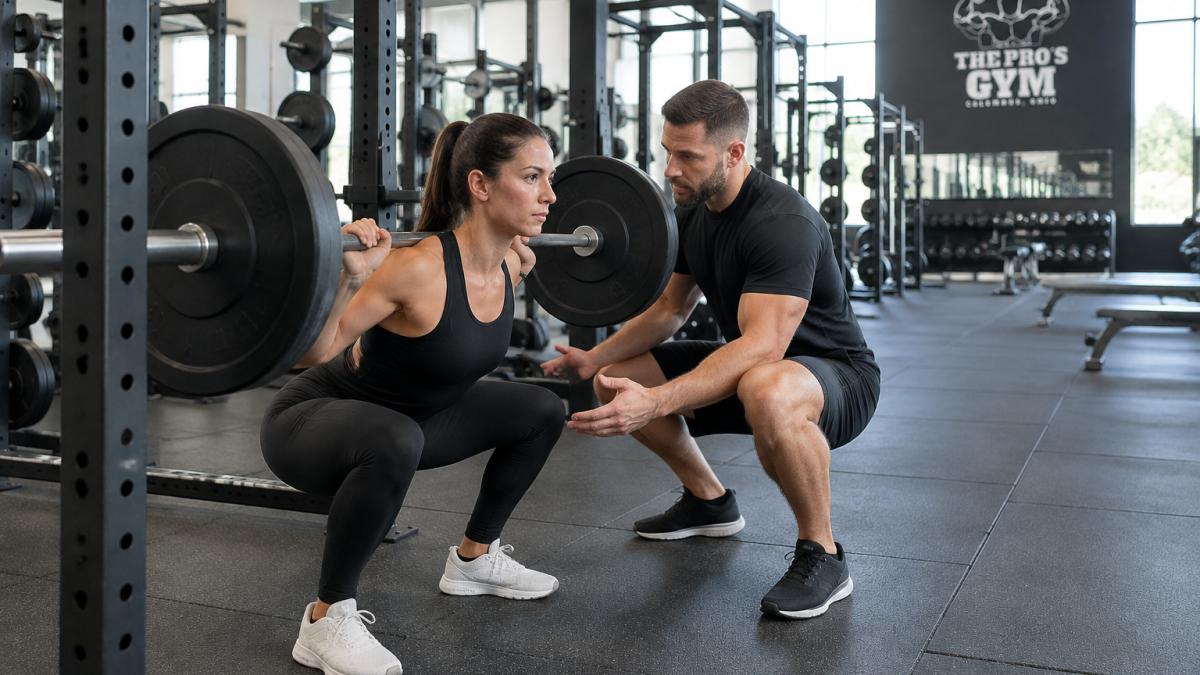
Training Formats: One-on-One, Partner, and Small-Group
One-on-one training is the highest-attention option. Every rep gets watched, every correction lands immediately.
Partner training splits the cost between two people while keeping a good deal of individual attention.
Small-group training runs several people through a shared session, which generally lowers the per-person cost compared with one-on-one work.
Whichever format you choose, ask one question before you sign: how many clients is the trainer coaching at the same time?
Quick Comparison: Personal Training Options and Pricing
| Option | Typical Billing | Attention Level | Best For |
|---|---|---|---|
| One-on-one sessions | Per session or 4-12 session packs | Highest | Beginners, technique work, injury history |
| Partner training | Split per-pair rate | High | Couples, friends, cost sharing |
| Small-group training | Monthly or per-block | Moderate | Budget-conscious lifters, accountability |
| Day and week passes | Flat fee | Self-directed | Travelers and short stays |
Two things drive the final number: how many sessions you commit to at once, and whether the gym bundles training with membership. Ask for full package terms in writing, including what happens to unused sessions.
Columbus Personal Training Prices: What Drives the Cost
Here is what to check before you compare quotes:
- Per-session rate versus package rate. Ask for both so you can compare the total cost of each option.
- Expiration terms. Ask how long sessions remain valid before you buy.
- Membership bundling. Ask whether training is billed with or separately from gym access.
Watch out: a lower per-session rate may depend on an upfront package payment. Check the refund terms before you commit.
A Practical Way to Compare Quotes Side by Side
When you are holding several quotes, a one-page comparison sheet with the same rows for each gym makes the differences easier to see.
Use these rows:
- Quoted per-session rate and how it changes with package size.
- Package minimum, if any.
- Expiration window for unused sessions.
- Cancellation and refund terms, including whether unused sessions are refundable or forfeited.
- Freeze policy, if one exists.
- Membership requirement, if any.
- Assessment and programming fees, if any.
- Trainer experience, and whether a specific trainer can be requested.
A lower advertised rate may reflect a different trainer experience level or package length. Know which one you are buying.
Questions That Reveal the Real Terms
Ask these in the same conversation, and write the answers down:
- "If I buy 12 sessions and use four, what happens to the other eight?"
- "Is the quoted rate locked for the length of the package, or can it change?"
- "If my trainer leaves, do I keep my rate with a replacement?"
Watch out: a low introductory rate that steps up after the first month or two is common. Get the post-introductory rate in writing before you sign.
What Changes the Number Most
If you want to see how a membership and training package fit together at our facility, you can explore membership options and compare what each tier includes.
Columbus Personal Training Membership Cost and Package Terms
Membership cost and training cost are two separate budgets, so compare them side by side before you decide. Some gyms include training with membership and others bill it separately.
Ask these questions before signing anything:
- Does the membership include training sessions, or are they billed separately?
- What is the cancellation notice period?
- Are unused sessions refundable, transferable, or forfeited?
That last one catches people. Introductory rates that change after an initial period are common across the industry, so get any future rate in writing.
If you want to see how a membership and training package fit together at our facility, you can explore membership options and compare what each tier includes.
Strength Training for Beginners: Your First Four Weeks
Strength training for beginners works best as a four-week on-ramp, not a sprint. Month one is not about a max lift; it is about learning the five core patterns: squat, hinge, push, pull, and carry. (Source: Federal Trade Commission guidance on gym memberships)
A realistic first month looks like this:
- Week 1: Two sessions. Bodyweight and empty-bar work. Focus on setup and breathing.
- Week 2: Three sessions. Add light load to the main lifts. Keep reps high and rest generous.
- Week 3: Three sessions. Introduce one accessory movement per pattern.
A common mistake is chasing soreness as proof of progress. Soreness fades as you adapt; better technique does not. If a trainer sells you on "muscle confusion" instead of progressive overload, walk away.
Recovery matters as much as the work. Our Axe & Sledge Farm Fed whey isolate delivers 25 grams of protein per serving with added digestive enzymes.

Personal Training for Athletes: Speed, Agility, and Sport-Specific Work
Personal training for athletes looks nothing like general fitness coaching.
Ask a prospective coach three things:
- Which sport and level have they coached before?
- How do they test speed and agility, and how often?
- How do they adjust programming when the competitive season starts?
A coach who cannot answer the third question may be running a general program. Speed and agility work is technical: poor footwork drills can reinforce bad patterns at speed.
Core strength deserves its own block. Rotational core work transfers to almost every sport, from throwing to sprinting, and it protects the lower back under heavy loads.
How to Evaluate Trainer Credentials, Safety, and Fit
Credentials are a starting point. A certification shows a trainer has passed an exam, and a good trainer keeps learning and can explain why a program looks the way it does. This section is a practical vetting checklist you can run in one visit and one phone call.
Step 1: Verify the Certification, Not Just the Claim
Ask which certifying organization issued the credential and whether it is current. Well-known bodies include the American Council on Exercise (ACE), the National Academy of Sports Medicine (NASM), the National Strength and Conditioning Association (NSCA), and the American College of Sports Medicine (ACSM).
Also ask for proof of current CPR and first aid training. Confirming this is a sensible baseline safety check.
Watch out: a certification you cannot verify with the issuing organization is a warning sign, regardless of how impressive the credentials look.
Step 2: Ask How They Assess and Modify
A serious trainer assesses before programming. Ask what the first session looks like and what gets measured: movement screen, baseline strength numbers, range-of-motion checks, or a conditioning test.
Injury history deserves its own question. Ask: "If an old injury flares up mid-program, what changes?" A good answer describes specific modifications, a referral path to a physical therapist when appropriate, and a plan to reintroduce the movement.
Step 3: Test for Fit With Concrete Questions
Personality fit matters, but you can probe it with specifics rather than vibes:
- "What would my first month look like?" A vague answer signals a template program. A good answer names the movements, the weekly frequency, and what progress would look like at week four.
- "How do you track progress?" Look for logged numbers, not impressions. Ask to see the format a current client uses.
- "What do you do when a client plateaus?" The answer separates programmers from rep counters. Look for changes to volume, intensity, exercise selection, or recovery rather than "we just push harder."
Step 4: Inspect the Facility for Safety Basics
Safety practices matter too. Ask whether the gym maintains and inspects its bars, benches, and plates, and whether there is a written inspection schedule. Torn bench pads, bent barbells, and frayed cables can signal wider maintenance problems.
Look for the basics that support heavy training: enough racks and plates for your session, collars on the bars, and a clear spotter policy for heavy lifts.
Step 5: Decide on Fit Before You Commit
Fit is the variable no certification captures. Before you buy a package, ask for a single session or short trial so you can judge coaching style: does the trainer explain the why, watch every rep, and adjust in real time?
A simple rule: if you cannot get clear answers to the questions above in one conversation, the program is probably not built around you.
Book Your First Session at Pros Gym
Finding the right Columbus personal training setup comes down to format, price transparency, and a coach who can explain the plan. Pros Gym has served the Columbus fitness community for over 20 years, with three full floors of brand-new and classic equipment for lifters, bodybuilders and powerlifters.
Ready to train like a pro? Book your first session and see how a real program feels.
The hard part is not finding a gym. It is finding one that takes heavy lifting as seriously as you do.
Frequently Asked Questions
Is $300 a month a lot for a personal trainer?
It depends on session frequency and format. Whether that is a lot depends on session frequency and format. The key is to compare cost per session, not just the monthly total. Ask what the package includes, whether sessions expire, and what the cancellation policy is.
What should I look for when choosing a personal trainer?
Start with a nationally recognized certification such as NASM, ACE, NSCA, or ACSM, and ask whether the trainer carries current CPR and first aid training. Then match their specialty to your goal: a trainer who coaches powerlifting will program differently than one focused on general weight loss. Ask how they assess new clients, how they track progress, and whether they have experience with your fitness level or injury history. A short consultation or trial session tells you more about communication style than any review.
How often should a beginner work with a personal trainer?
Two sessions per week for the first four to six weeks is a common starting point. That gives you enough supervised practice to learn squat, hinge, push, and pull patterns safely while leaving recovery days between sessions. Many beginners then move to one session per week plus independent workouts once form is solid. The right frequency depends on your schedule, budget, and how quickly you pick up technique, so discuss it openly with your trainer rather than committing to a long package upfront.
Is personal training worth it for strength training?
For most lifters, yes, at least for a short block. A trainer can catch form faults you may not see yourself and help set a progression that suits your current strength. This matters most for beginners and for lifters returning from a layoff. Experienced powerlifters may only need occasional technique checks. Look for a trainer who programs actual progressive overload with logged sets and reps, not just circuits that leave you tired but not stronger.
What is the 3-3-3 rule at the gym?
The 3-3-3 rule is a popular framework for structuring a workout: three exercises per muscle group or movement pattern, three sets per exercise, and three reps in reserve on each set. It is a simple way to keep volume manageable and avoid training to failure on every set. It is not a formal standard from any certifying body, so treat it as a guideline. Beginners should start lighter and leave more reps in reserve while learning technique, then tighten the rep range as form becomes consistent.
