

Heavy Duty Squat Racks for Gyms: A Buying Guide
Table of Contents
- What Makes a Squat Rack Heavy Duty
- Power Rack vs Squat Rack: Which Fits Your Gym
- Squat Rack Weight Capacity: Why It Matters for Commercial Use
- Critical Safety Features in Heavy Duty Squat Racks
- Gym Rack Accessories and Customization Options
- Space, Footprint, and Installation Considerations
- Durability, Maintenance, and Long-Term Value
- Frequently Asked Questions
Last Updated: October 21, 2026
What Makes a Squat Rack Heavy Duty
A heavy duty squat rack is engineered to withstand repeated, intense loading from serious lifters and high-volume gyms. The difference from a standard rack comes down to materials, weight capacity, and frame stability.
Heavy duty squat racks use thicker steel, typically 11-gauge or thicker, with reinforced 3x3 uprights and cross-bracing built for loads well beyond casual use.
A properly constructed heavy duty squat rack won't wobble under load, develop play in the J-cups, or need constant maintenance.
The key factors separating heavy duty construction from standard racks are steel gauge thickness, weld quality, base footprint stability, and weight capacity rating.
Power Rack vs Squat Rack: Which Fits Your Gym
The distinction between a power rack and a squat rack matters for facility planning, though many gym owners confuse the terms.
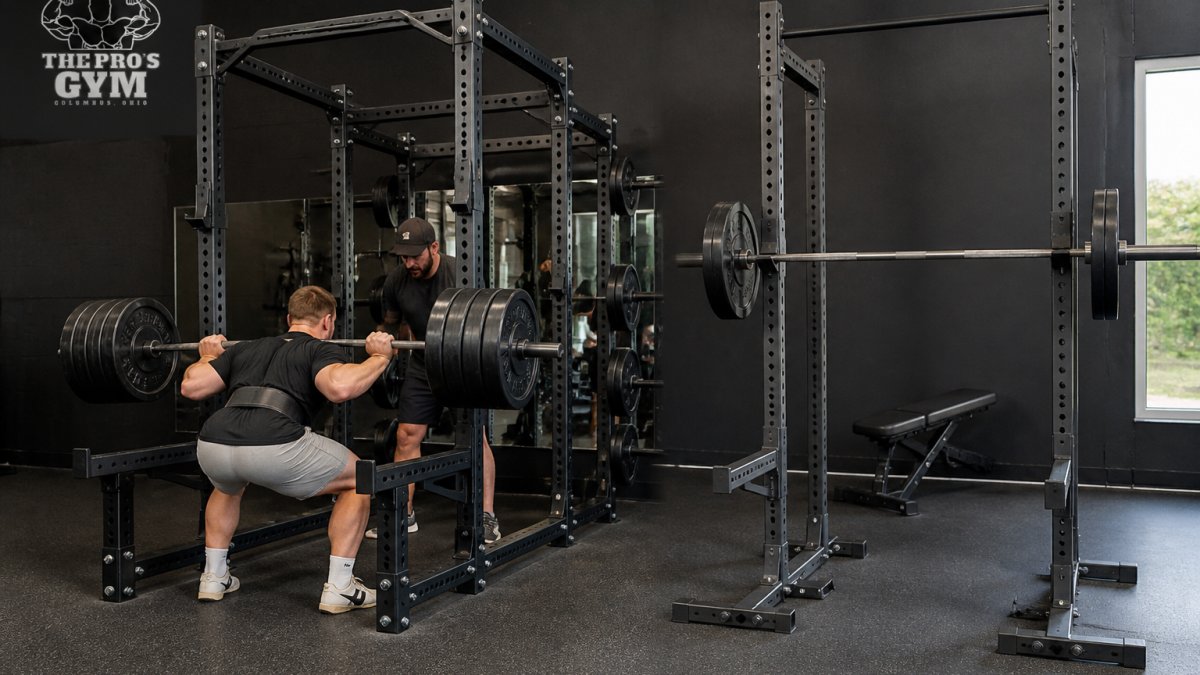
A power rack is a fully enclosed four-upright cage with safety bars and spotter arms.
A squat rack, by contrast, typically has two uprights and an open design. It's built specifically for squat movements and takes up less floor space.
For multi-use gyms, a power rack delivers better throughput: one unit handles squats, pressing, and other compound movements, reducing peak-hour crowding.
If your facility emphasizes powerlifting, power racks are the stronger choice; if space is limited or you prioritize squat-specific training, squat racks work well.
Squat Rack Weight Capacity: Why It Matters for Commercial Use
Weight capacity is the most important spec for any heavy duty squat rack, but the number is only useful if you know what it measures. Two racks can both advertise 1,000-pound capacity while behaving very differently under a 600-pound squat, because ratings aren't standardized. Normalize the claim before you compare.
What a Capacity Rating Actually Measures
Most commercial-grade squat racks carry ratings between 500 and 1,500 pounds, a wide range because manufacturers test differently. Some publish a static load rating (holds a stationary load without permanent deformation), others a tested working load (accounts for repeated use and dynamic forces), and a few a maximum capacity reflecting a single-event threshold.
When evaluating a rack, ask: Is the rating static or dynamic? A working load or a failure threshold? Does the manufacturer publish the test method? A documented test protocol is easier to defend in a facility specification than a bare number.
Normalizing Specs Across Models
Capacity means little without the frame dimensions that produce it. Compare racks using consistent measures rather than marketing language:
- Steel gauge and upright size. 11-gauge steel in 3x3-inch uprights is a common commercial baseline; 12- or 14-gauge steel in 2x2 or 2x3 uprights is lighter-duty. Thicker gauge and larger uprights generally correlate with higher tested capacity, but only if welds and bracing match.
- Hole spacing. 2-inch spacing is standard and gives finer J-cup and safety-bar adjustment; 1-inch spacing (Westside-style) offers more precision but requires compatible attachments. Spacing affects usable safety height more than raw capacity.
- Rack depth and footprint. Deeper racks distribute load across a larger base and resist tipping, but consume more floor space. A 30-inch-deep rack and a 48-inch-deep rack with the same rating behave differently under a failed lift.
- Base and anchoring. Bolt-down holes, base plates, and cross-members determine whether the rated capacity is achievable without the rack walking or rocking.
Build a one-page comparison sheet with columns for gauge, upright dimensions, hole spacing, depth, footprint, published capacity, and test method, filled in from spec sheets rather than product photos. The rack that wins after normalization usually holds up in service.
Capacity, Safety Margin, and Throughput
For gym operations: a 500-pound capacity rack works for general fitness but is inadequate for serious strength athletes.
For commercial gyms with multiple daily users, each session creates cumulative wear. A rack rated for 800 pounds handling daily 600-pound attempts degrades faster than one rated for 1,200 pounds under the same loads.
Choose a rating that exceeds your highest anticipated load by at least 200-300 pounds to account for dynamic loading, wear, and unexpected stress.
Critical Safety Features in Heavy Duty Squat Racks
Safety features separate equipment that protects users from equipment that creates risk. The best heavy duty squat racks include redundant safety systems.
Spotter arms are horizontal supports at chest height inside the rack; if you fail a lift, the barbell rests on them rather than crushing you.
Safety bars work similarly but sit lower, at waist or hip height, catching the barbell if you lose control during a squat.
J-cups hold the barbell before the lift.
Base footprint and anchoring determine whether the rack stays planted under load.
The rack should feel rock-solid when loaded. Any wobble, flex, or movement signals inadequate construction, test under realistic loads before buying.
Gym Rack Accessories and Customization Options
Heavy duty squat racks become more versatile with the right accessories.
Plate storage pegs attach to the uprights, holding weight plates on the rack to keep them organized and reduce floor clutter.
Dip attachments bolt to the frame, adding dip capability without separate equipment and expanding upper-body training options.
Pull-up bars mount across the top of the rack, adding vertical pulling exercises. Some racks include multiple grip widths or neutral-grip options.
The best heavy duty squat racks use standardized hole spacing (typically 2-inch intervals) so accessories from multiple manufacturers fit.
Space, Footprint, and Installation Considerations
Commercial gym space is expensive. Every piece of equipment must justify its footprint. Understanding rack dimensions and installation requirements prevents costly mistakes.
A typical power rack occupies roughly 8 feet by 5 feet of floor space. Full racks run 7 to 8 feet tall.
For multi-user gym operations, consider not just the equipment footprint but the space needed for loading, unloading, and spotting.
Installation requirements vary by rack type. Movable racks need only a level floor and enough clearance for users.
Before purchasing, measure your available space and plan for equipment placement. Account for walking paths, other equipment, and user movement.
Durability, Maintenance, and Long-Term Value
The true cost of a heavy duty squat rack is not the purchase price, it is the total cost of ownership over 5, 10, or 20 years of operation, plus the operational risk of downtime during peak hours. Most visible buying guides stop at the sticker price. Facility buyers need a model that includes shipping, installation, inspection labor, replacement parts, and the cost of a station going out of service.
Building a Total Cost of Ownership Model
A workable model has five line items per rack:
- Equipment cost. Commercial heavy duty racks commonly fall in the $2,000-$4,000 range per unit, with premium and specialty configurations running higher. Consumer racks in the $600 range are not built for daily multi-user service.
- Shipping and delivery. Freight for a rack is a real line item, especially for multiple units. Ask for delivered pricing rather than list pricing, and confirm whether liftgate or inside delivery is included.
- Installation and anchoring. Bolt-down installation requires drilling concrete, setting anchors, and verifying level. Budget labor for each station, and confirm whether the rack ships with anchoring hardware or requires a separate purchase.
- Inspection and maintenance labor. A monthly inspection of J-cups, safety bars, welds, and fasteners takes staff time. Multiply by rack count and months of operation to get an annual figure.
- Replacement parts and downtime. J-cups, safety bars, and hardware wear out. Parts availability and lead time determine whether a worn component is a quick swap or a station closed for weeks.
A simple per-session calculation makes the comparison concrete: a $3,000 commercial rack used daily for 15 years costs roughly $0.55 per day of service before maintenance, while a $600 consumer rack that fails after 3 years costs more per day and disrupts your facility when it goes down. The commercial rack wins on cost per session and on uptime.
Inspection Schedule and Safe Load Ratings
Durability is maintained, not assumed. A practical inspection cadence for a commercial facility:
- Daily (staff walk-through): Check that J-cups and safety bars are seated and locked, and that the rack does not rock.
- Monthly: Inspect welds for cracks, check fasteners for loosening from vibration, and confirm anchoring is tight. Look for wear on J-cup liners and safety-bar padding.
- Quarterly: Review high-use stations for frame flex, corrosion, and finish wear. Re-torque hardware per the manufacturer's specification.
- Annually: Conduct a full structural review and document it. Keep records, they support both maintenance planning and liability defense.
Safe load ratings should be posted at each station and matched to the rack's tested working load, not its maximum threshold. Staff should know which racks are rated for heavy powerlifting and which are general-use stations.
Serviceability and Long-Term Compatibility
A rack is only durable if it can be serviced. Before you buy, confirm that the manufacturer stocks replacement J-cups, safety bars, pins, and hardware, and ask for typical lead times. A rack with proprietary attachments and no parts channel becomes disposable the first time a component fails.
Compatibility matters as the gym grows. Standardized 2-inch hole spacing and common upright dimensions let you add attachments from multiple sources and expand stations over time. Avoid racks with proprietary attachment systems that lock you into one brand's ecosystem, and favor designs where the same J-cups and safety arms fit multiple rack models in the line.
Warranty as a Durability Signal
Warranty terms indicate manufacturer confidence. Reputable heavy duty racks come with 5- to 10-year structural warranties. Short warranties or no warranty signal lower quality or a home-gym product being marketed to facilities. Read the warranty for what it excludes, finish, wear parts, and cosmetic damage are commonly excluded, and those exclusions tell you what the manufacturer expects to fail first.
For long-term gym operations, investing in quality heavy duty squat racks pays dividends through uptime, lower maintenance labor, and predictable replacement cycles. The rack that costs more up front but stays in service for 15 years is the cheaper asset, and the one that protects your members and your reputation.
Frequently Asked Questions
What is the difference between a squat rack and a power rack?
A squat rack has two vertical uprights and holds a barbell at shoulder height for squats. A power rack (or power cage) is a full enclosure with four uprights, crossbeams, and safety bars on all sides, allowing exercises in multiple planes. Power racks offer more safety and versatility for commercial gyms handling diverse training styles, while squat racks save floor space. For heavy duty use with multiple athletes, a power rack's enclosed design reduces injury risk.
How much weight should a commercial heavy duty squat rack support?
Commercial squat racks should support a significant weight capacity to handle serious strength athletes and accommodate multiple users daily. Weight capacity depends on frame construction (11-gauge steel is standard for heavy duty), upright diameter (3x3 inches is common), and hole spacing. Verify the manufacturer's load rating matches your gym's strongest athletes and accounts for dynamic loading during drops and failed lifts.
What safety features matter most in a squat rack for a busy gym?
Spotter arms and adjustable safety bars are essential, they catch the barbell if a lifter fails, preventing injury and equipment damage. Look for racks with fine hole spacing (2-inch increments or closer) so safety bars adjust to the exact height needed. Heavy duty construction with 11-gauge steel or thicker, secure J-cups that grip the barbell firmly, and stable base anchoring prevent tipping. For commercial use, ensure the rack has a warranty covering heavy daily use.
What gym rack accessories should I prioritize for heavy duty squat racks?
Plate storage pegs, dip attachments, and lat pulldown systems maximize equipment utility in limited space. Adjustable J-cups accommodate different barbell diameters. Safety bar converters and specialty bar holders expand training options. For commercial gyms, prioritize accessories that reduce injury risk. Ensure all accessories bolt securely to the frame and withstand repetitive use. Modular designs let you add attachments later without replacing the entire rack.