

How to Choose Between Powerlifting and Bodybuilding Training
Last Updated: October 26, 2026
Quick Summary
Powerlifting vs bodybuilding differ in core goals: powerlifting prioritizes maximal strength in the squat, bench press, and deadlift, while bodybuilding prioritizes muscle definition and physique aesthetics. Powerlifting uses heavy loads and low reps in the 1-5 range, while bodybuilding uses moderate loads and higher reps in the 6-12 range.
- Powerlifting competitions score only the heaviest single repetition in three lifts; bodybuilding competitions judge muscle size, symmetry, conditioning, and stage presentation.
- Powerlifters train each competition lift once or twice weekly at 85-95% intensity; bodybuilders train each muscle group once or twice weekly with more total exercises and higher weekly volume.
- Powerlifters measure progress in pounds on the bar and meet totals; bodybuilders measure progress in circumference measurements, body-fat estimates, and progress photos.
- Powerlifting emphasizes nervous system adaptation and maximal strength; bodybuilding emphasizes metabolic stress and muscle hypertrophy.
- Powerbuilding combines strength and hypertrophy by cycling between heavy phases and moderate-weight, higher-rep phases.
Table of Contents
- Powerlifting vs Bodybuilding: Core Training Goals
- How Competition and Judging Differ
- Exercise Selection: Compound Movements vs Isolation
- Powerlifting Workout Routine: Squat, Bench Press, and Deadlift
- Bodybuilding Workout Routine: Building Muscle Definition and Aesthetics
- Powerlifting Sets and Reps vs Training Volume
- Powerbuilding Program: Combining Strength and Hypertrophy
- Progressive Overload, Recovery, and Long-Term Success
- Frequently Asked Questions
Powerlifting vs Bodybuilding: Core Training Goals
When comparing powerlifting vs bodybuilding, the difference comes down to your goal. Powerlifting prioritizes maximal strength in three specific lifts. Bodybuilding prioritizes muscle definition and physique aesthetics across your entire body.
These are fundamentally different training philosophies that shape your routine, reps and sets, recovery fueling, and progress tracking.
Understanding which aligns with your goals, or whether a hybrid approach makes sense, is the first decision that matters. Start strength training for beginners with foundational knowledge before choosing between these training styles.
The core tension is simple: maximal power versus muscle hypertrophy. One emphasizes heavy loads and low volume, the other moderate loads and high volume. Both build muscle, but recovery demands and long-term progression differ noticeably.
How Competition and Judging Differ
Powerlifting and bodybuilding competitions are judged on completely different criteria, and those criteria cascade into every training decision.
Powerlifting judging. A powerlifting meet measures one thing: the heaviest single repetition you can complete in the squat, bench press, and deadlift.
Bodybuilding judging. A bodybuilding show judges your physique: muscle size, symmetry, proportion, conditioning, and stage presentation. Judges compare competitors through mandatory poses and a posing routine under stage lighting.
What this means for training. The judging criteria explain the training split.
What this means for body composition. Powerlifters often eat in a slight surplus to support recovery and leverage, and many compete at a higher body-fat percentage than bodybuilders.
What this means for progress measurement. Powerlifters measure progress in pounds on the bar and in meet totals.
A practical decision guide: choose powerlifting if you enjoy heavy singles and want a measurable strength goal without strict body composition management. Choose bodybuilding if you enjoy training many muscle groups and will manage nutrition closely. Choose a hybrid if you want strength and size without peaking for either competition.
Exercise Selection: Compound Movements vs Isolation
Powerlifting revolves around three compound exercises: the squat, bench press, and deadlift. These are the only lifts that matter in competition. Everything else is supplemental.
Powerlifters still use accessory work to strengthen weak points, but the focus is clear: get stronger at the three competition lifts.
Bodybuilding uses compound exercises too, but adds substantial isolation work: leg curls, cable flyes, lateral raises, bicep curls, tricep extensions.
A powerlifter might do heavy squats, then add a few sets of leg press.
Compound movements build overall strength and muscle; isolation movements build specific definition and shape. Both matter for hypertrophy, but bodybuilders prioritize isolation work to target lagging muscle groups precisely.
Powerlifting Workout Routine: Squat, Bench Press, and Deadlift
A typical powerlifting workout routine focuses on the three competition lifts. Most powerlifters train each lift once or twice per week, with intensity structured around percentages of their one-rep max.
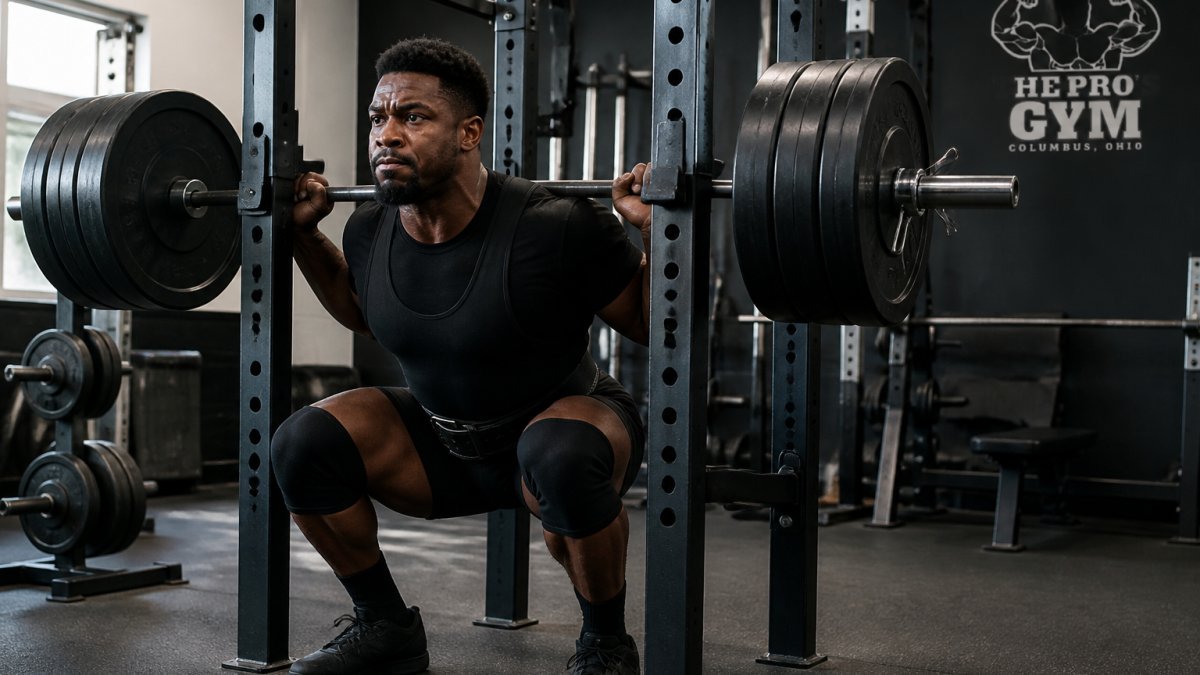
A common structure looks like this:
Monday: Squat Focus
- Heavy squat: 3-5 sets of 1-3 reps at 85-95% of one-rep max
- Accessory squat work: 3-4 sets of 5-8 reps (box squats, front squats, or paused squats)
- Supplemental leg work: 2-3 sets of 6-10 reps (leg press or hack squat)
Wednesday: Bench Press Focus
- Heavy bench: 3-5 sets of 1-3 reps at 85-95% of one-rep max
- Accessory bench work: 3-4 sets of 5-8 reps (incline bench, close-grip bench, or paused bench)
- Supplemental pressing: 2-3 sets of 8-12 reps (dumbbell press or machine work)
Friday: Deadlift Focus
- Heavy deadlift: 2-4 sets of 1-3 reps at 85-95% of one-rep max
- Accessory deadlift work: 3-4 sets of 3-5 reps (deficit deadlifts, paused deadlifts, or rack pulls)
- Supplemental back work: 2-3 sets of 6-10 reps (rows or lat pulldowns)
The powerlifting training style emphasizes heavy weight and low reps, mostly in the 1-5 rep range. This builds maximal strength and nervous system adaptation, and recovery is critical because the load is intense.
Bodybuilding Workout Routine: Building Muscle Definition and Aesthetics
A bodybuilding workout routine spreads training volume across more exercises and higher reps. Most bodybuilders train each muscle group once or twice per week using moderate to heavy weight in moderate rep ranges.
A common structure looks like this:
Axe & Sledge Farm Fed 100% Whey Protein Isolate – 25g Protein with Digestive →
Monday: Chest and Triceps
- Barbell bench: 4 sets of 6-8 reps
- Incline dumbbell press: 3 sets of 8-10 reps
- Cable flyes: 3 sets of 10-12 reps
- Dips: 3 sets of 8-10 reps
- Rope pushdowns: 3 sets of 10-12 reps
- Overhead extensions: 3 sets of 10-12 reps
Wednesday: Back and Biceps
- Barbell rows: 4 sets of 6-8 reps
- Pull-ups: 3 sets of 8-10 reps
- Machine rows: 3 sets of 10-12 reps
- Barbell curls: 3 sets of 8-10 reps
- Dumbbell curls: 3 sets of 10-12 reps
- Cable curls: 3 sets of 10-12 reps
Friday: Legs
- Barbell squats: 4 sets of 6-8 reps
- Leg press: 3 sets of 8-10 reps
- Leg curls: 3 sets of 10-12 reps
- Leg extensions: 3 sets of 10-12 reps
- Calf raises: 3 sets of 12-15 reps
The bodybuilding training style emphasizes moderate weight and higher reps, mostly in the 6-12 rep range with some higher-rep isolation work. This builds hypertrophy and definition, and the lower intensity per set means more total volume can be tolerated.
Powerlifting Sets and Reps vs Training Volume
The rep range difference reflects different goals: powerlifting prioritizes heavy loads and nervous system adaptation, while bodybuilding prioritizes muscle damage and metabolic stress.
Powerlifting sets and reps typically follow this pattern:
- Main lifts: 1-5 reps per set, 3-5 sets total, 85-95% intensity
- Accessory work: 3-8 reps per set, 3-5 sets total, 70-85% intensity
- Total weekly volume: lower overall, but high intensity
Bodybuilding sets and reps typically follow this pattern:
- Main lifts: 6-8 reps per set, 3-4 sets total, 70-80% intensity
- Isolation work: 8-12 reps per set, 3-4 sets total, 60-75% intensity
- Total weekly volume: higher overall, moderate intensity
Training volume is the total weight moved across all sets and reps. A powerlifter might move 50,000 pounds in a week; a bodybuilder might move 80,000. Higher volume creates more metabolic stress and muscle damage, driving hypertrophy; lower volume with higher intensity builds maximal strength.
Neither approach is "better." They're optimized for different outcomes. A powerlifter doesn't need high volume to get strong. A bodybuilder doesn't need low reps to build muscle.
Powerlifting and bodybuilding differ fundamentally in rep ranges, intensity, and total weekly volume.
| Aspect | Powerlifting | Bodybuilding |
|---|---|---|
| Main lift reps | 1-5 reps per set | 6-8 reps per set |
| Main lift intensity | 85-95% | 70-80% |
| Accessory reps | 3-8 reps per set | 8-12 reps per set |
| Accessory intensity | 70-85% | 60-75% |
| Total weekly volume | Lower overall, high intensity | Higher overall, moderate intensity |
| Primary adaptation | Nervous system, maximal strength | Metabolic stress, muscle hypertrophy |
Powerbuilding Program: Combining Strength and Hypertrophy
Many athletes find pure powerlifting or pure bodybuilding doesn't match their goals. Some want strength plus a better physique; others want aesthetic muscle plus serious weight. This is where powerbuilding comes in.
Powerbuilding combines the strength focus of powerlifting with the hypertrophy focus of bodybuilding. The structure typically looks like this:
Main Strength Phase (Heavy)
- Squat, bench, or deadlift: 4-5 sets of 2-4 reps at 85-90% intensity
- Accessory compound: 3-4 sets of 5-6 reps at 75-80% intensity
Hypertrophy Phase (Moderate Weight, Higher Reps)
- Compound variation: 3-4 sets of 6-8 reps
- Isolation work: 3-4 sets of 8-12 reps
The powerbuilding program cycles between strength and hypertrophy phases.
Progressive Overload, Recovery, and Long-Term Success
Progressive overload is the common engine behind both powerlifting and bodybuilding, but how you apply, measure, and recover from it differs by goal.
How overload actually works. Muscle and strength adapt when training stress exceeds what the body is prepared for. The main levers are load, volume, effort (proximity to failure), and frequency.
- Powerlifting overload is primarily load-driven. You add weight to the competition lifts, cycle intensity across weeks, and test with heavy singles or a meet. Volume supports the main lifts through accessory work. Most practitioners find that strength responds well to heavy loads in the 1 to 5 rep range taken close to technical failure, with enough volume to drive adaptation without excessive fatigue.
- Bodybuilding overload is primarily volume- and effort-driven. You add sets, reps, or load while keeping most working sets in the 6 to 12 rep range and taking isolation work close to failure. Hypertrophy responds to sufficient volume and mechanical tension, so bodybuilders often progress by adding reps or sets before adding weight.
Proximity to failure matters more than a fixed rep range. Both styles build muscle when sets are taken sufficiently close to failure with adequate volume.
How to measure progress in each style.
- Powerlifting: competition-lift PRs, estimated one-rep max from a heavy triple or single, meet totals, and technique quality under heavy load. Track bar speed and missed attempts as warning signs.
- Bodybuilding: circumference measurements, body-fat estimates, progress photos under consistent lighting, rep PRs at a given weight, and stage or posing feedback. Strength on compound lifts is a useful secondary marker but not the primary one.
- Hybrid: track both. Use a strength marker on the squat, bench press, and deadlift and a physique marker such as waist, arm, and thigh measurements taken at the same time of day.
Recovery differences by goal. Powerlifting places a premium on sleep, nervous-system readiness, and managing heavy-load fatigue. Bodybuilding places a premium on calorie and protein intake to support volume and body-composition goals.
Nutrition and body composition. Neither style requires a single diet. Powerlifters prioritize calories and protein for recovery and leverage, often accepting a higher body-fat level.
Long-term success. Consistency beats program hopping. The most common mistakes are changing programs every few weeks, neglecting weak points, and ignoring recovery signals. Powerlifters who only train the competition lifts plateau because weak links limit the total; bodybuilders who avoid heavy compound work miss size and strength gains. A sustainable plan addresses the main goal and the weak links, with a measurement system so you know it's working.
Frequently Asked Questions
What is the main difference between powerlifting and bodybuilding training?
Powerlifting focuses on maximal strength in three lifts: the squat, bench press, and deadlift. Bodybuilding prioritizes muscle hypertrophy and aesthetic physique development through higher rep ranges and greater training volume. Powerlifters compete by lifting the heaviest weight possible; bodybuilders are judged on muscle size, symmetry, and definition. Both use progressive overload, but powerlifting emphasizes heavy loads with fewer reps, while bodybuilding uses moderate weight with higher reps and shorter rest periods.
Can you combine powerlifting and bodybuilding training in one program?
Yes. A powerbuilding program blends powerlifting's strength focus with bodybuilding's hypertrophy work. Typically, you perform heavy compound lifts, squat, bench press, deadlift, in lower rep ranges (3-6 reps) to build maximal strength, then follow with isolation exercises in higher rep ranges (8-12 reps) to stimulate muscle growth.
Which training style is better for building muscle?
Bodybuilding training is specifically designed for muscle hypertrophy through higher rep ranges (8-15 reps), greater training volume, and shorter rest periods. However, powerlifting also builds muscle because heavy compound exercises stimulate significant muscle growth. Your choice depends on whether aesthetics or maximal strength is your primary goal.
What rep ranges and set structure should I use for powerlifting sets and reps?
Powerlifting typically uses lower rep ranges: 1-5 reps per set for maximal strength work on the squat, bench press, and deadlift. You perform fewer sets per exercise (2-5 sets). This structure prioritizes lifting heavy weight with perfect technique. Bodybuilding uses 8-15 reps per set with 3-4 sets per exercise.
