

Strength Training for Beginners 2026: Your Guide
Table of Contents
- Why Strength Training for Beginners 2026 Looks Different
- Beginner Strength Training Program: An 8-Week Plan You Can Adapt
- How Many Days a Week Should Beginners Strength Train?
- Strength Training Exercises for Beginners: The Core Six
- Strength Training Equipment for Beginners: What You Actually Need
- Sets, Reps, and How Long a Beginner Workout Should Last
- Recovery, Soreness, and Nutrition Basics for Strength Gains
- Conclusion: Start Light, Stay Consistent, Track Progress
- Frequently Asked Questions
Last Updated: October 14, 2026
Why Strength Training for Beginners 2026 Looks Different
Strength training for beginners in 2026 is more accessible than ever: commercial gyms offer guided machines, free weights in every increment, and staff who can show you how to use them.
The biggest change is not the equipment but the culture. Beginners today have more information, more coaching, and more welcoming environments than in recent memory, and that matters, because the barrier for most new lifters has never been physical.
What Changes This Year for New Lifters
Two things stand out: 24-hour access is becoming standard rather than a premium perk, and the stigma around starting weak has largely faded.
The CDC physical activity guidelines recommend adults perform muscle-strengthening activities at least two days per week. That is a modest target, and it is the right place to start.
Beginner Strength Training Program: An 8-Week Plan You Can Adapt
Most beginner programs tell you what to do but not what to do when week 3 feels different from week 1. This plan fixes that: eight weeks, a specific job for every week, and a home and gym version of every movement.
Total time per session: 45-60 minutes Frequency: Three days per week, with at least one rest day between sessions Structure: Full body each session, alternating an A day and a B day
The Two Workouts You Will Repeat
Rotate A and B across the week: Monday A, Wednesday B, Friday A, then start the following week with B. This spreads the same movement patterns across the week without repeating a session back to back.
Workout A
| Pattern | Gym Version | Home Version |
|---|---|---|
| Squat | Goblet squat or back squat | Bodyweight squat or dumbbell goblet squat |
| Horizontal push | Dumbbell bench press or machine chest press | Push-up, incline push-up on a counter, or floor press |
| Horizontal pull | Seated cable row or chest-supported row | One-arm dumbbell row braced on a chair |
| Hinge accessory | Romanian deadlift | Dumbbell Romanian deadlift |
| Core | Dead bug or plank | Dead bug or plank |
Workout B
| Pattern | Gym Version | Home Version |
|---|---|---|
| Hinge | Trap bar deadlift or conventional deadlift | Dumbbell Romanian deadlift or hip hinge drill |
| Vertical push | Dumbbell or machine shoulder press | Seated dumbbell press or pike push-up |
| Vertical pull | Lat pulldown or assisted pull-up | Band pull-down or dumbbell pullover |
| Single-leg | Split squat or step-up | Bodyweight split squat or step-up on a stair |
| Carry | Farmer's carry | Farmer's carry with dumbbells or heavy grocery bags |
Week-by-Week Progression
Weeks 1-2 are about learning the movements. Weeks 3-4 add a set. Weeks 5-6 add load. Weeks 7-8 push close to your working limit, then you deload.
| Week | Sets Per Exercise | Rep Target | What to Focus On |
|---|---|---|---|
| 1 | 2 | 8-10 | Technique. Stop every set with 3-4 reps left in reserve. |
| 2 | 2 | 8-10 | Same weights as week 1. Add one rep per set if form holds. |
| 3 | 3 | 8-10 | Add the third set. Keep the same weight. |
| 4 | 3 | 8-10 | Add a small increment where you hit the top of the range on all sets in week 3. |
| 5 | 3 | 8-10 | Add load again where you hit the top of the range. |
| 6 | 3 | 8-10 | Push to 2 reps in reserve on the last set of each exercise. |
| 7 | 3 | 8-10 | Heaviest week. Stay at 1-2 reps in reserve, never to failure. |
| 8 | 2 | 8-10 | Deload. Drop the third set and reduce load by roughly 20 percent. |
After week 8, repeat the cycle with your new starting weights. Most beginners find their week 1 numbers in the second cycle are close to their week 4 numbers from the first.
What to Do When You Stall
Progress is not linear, and a stalled lift is normal. Work through this order before changing anything else.
- Repeat the weight. If you missed reps at a given load, run the same weight next session. Two sessions at the same weight is not a plateau.
- Add a rep before adding weight. Stuck at 8 reps on all sets? Aim for 9 or 10 at the same load before reaching for a heavier dumbbell.
- Check the basics. Sleep, protein, and session spacing cause more stalls than programming does.
- Deload early if you need to. If two or three lifts stall in the same week, take a deload week rather than grinding through it.
- Change the variation, not the pattern. Swap a goblet squat for a split squat or a dumbbell bench for an incline press. Keep the pattern, change the angle.
How to Measure Progress Beyond the Scale
Body weight is the least useful number in your first two months. Track these instead:
- Load: the weight on the bar or dumbbell for each main lift, week over week.
- Reps at a given load: going from 3 sets of 8 to 3 sets of 10 at the same weight is real progress.
- Consistency: sessions completed out of sessions planned. Twelve out of twelve beats eight out of twelve every time.
A one-page log with columns for date, exercise, weight, reps, and a note is enough. Review it every four weeks and you will see the trend even on flat weeks.
How Many Days a Week Should Beginners Strength Train?
Three days per week is the sweet spot for most beginners: enough stimulus to build strength while leaving adequate recovery time.
Two days per week works if your schedule is tight; four is fine if you split into upper and lower body sessions. What matters more than the exact number is consistency, three focused sessions repeated for months will outperform five sporadic ones.
| Days Per Week | Best For | Session Length | Example Split |
|---|---|---|---|
| 2 | Tight schedules, return after a long break | 45 min | Full body both days |
| 3 | Most beginners | 45-60 min | Full body, alternating focus |
| 4 | Faster progress, more available time | 45 min | Upper/lower split |
Strength Training Exercises for Beginners: The Core Six
Six movements cover nearly everything a new lifter needs. Master these before adding variety.
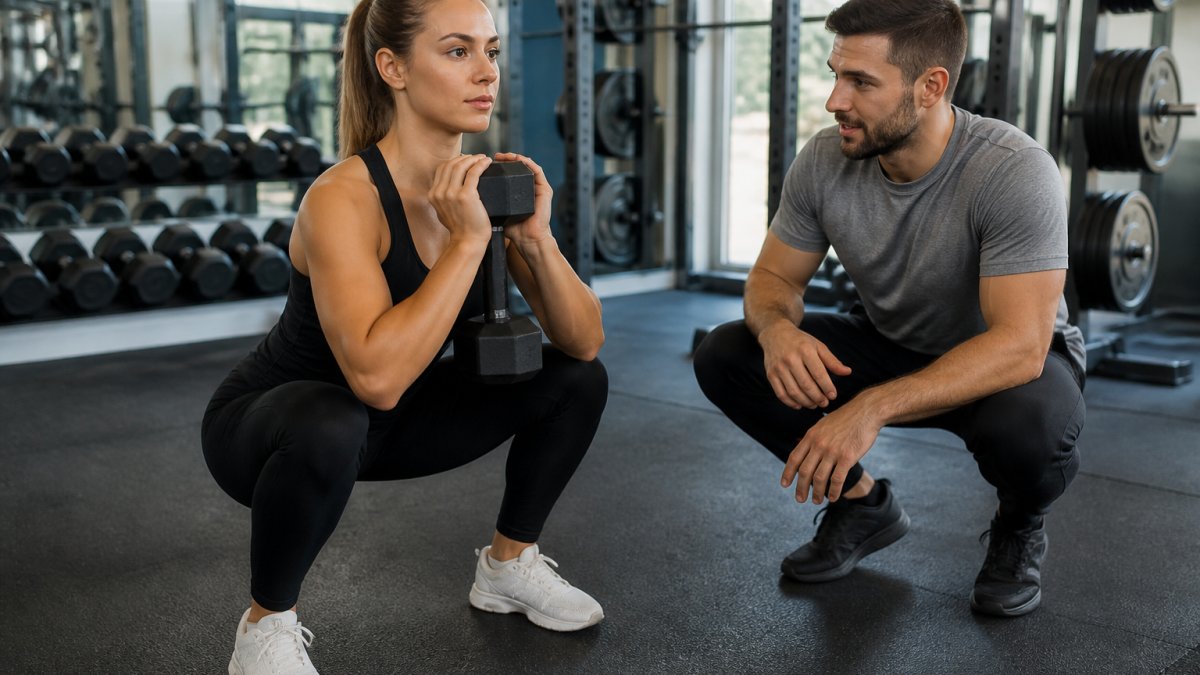
- Squat, trains quads, glutes, and core stability
- Deadlift or hip hinge, trains hamstrings, glutes, and back
- Push-up or bench press, trains chest, shoulders, and triceps
- Row, trains upper back and biceps
- Shoulder press, trains shoulders and triceps
- Farmer's carry, trains grip, core, and overall conditioning
How to Pick Starting Weights and Progress Them
Start lighter than you think you should. If you complete your target reps with clean technique and had three or more reps left, the weight is appropriate.
Progression follows a simple pattern: when you hit the top of your rep range on every set for two consecutive sessions, add a small increment, 2.5 to 5 pounds upper body, 5 to 10 pounds lower body.
Strength Training Equipment for Beginners: What You Actually Need
You do not need much. A pair of adjustable dumbbells, a mat for floor work, and a water bottle will cover most of your first two months.
At a gym, you have access to everything without the upfront cost. Free weights, racks, and machines let you learn each movement pattern safely, while a yoga mat helps for floor exercises and stretching.
If you want to support recovery between sessions, protein intake matters. Our Axe & Sledge Farm Fed Whey Protein Isolate delivers 25 grams of protein per serving with digestive enzymes for easier absorption. A stainless steel water bottle and a Pro's Fitness Club Towel round out a basic gym bag.


Sets, Reps, and How Long a Beginner Workout Should Last
A beginner workout should last 45 to 60 minutes including warm-up, enough time for a thorough session without fatigue becoming the limiting factor.
Axe & Sledge Farm Fed 100% Whey Protein Isolate – 25g Protein with Digestive →
For sets and reps, beginners do well with 2-3 sets of 8-12 reps per exercise.
Warm up with five to ten minutes of light cardio and dynamic movement. This raises your core temperature and prepares your joints for loading.
Recovery, Soreness, and Nutrition Basics for Strength Gains
Recovery is where training actually turns into strength. Beginners tend to under-sleep, under-eat protein, and over-interpret soreness. Here are concrete targets and a simple way to tell normal soreness from a signal to stop.
Soreness: Normal vs. Warning Sign
Delayed onset muscle soreness, or DOMS, is the dull, achy, generalized soreness that shows up 12 to 48 hours after a new or harder session. It fades with consistent training, usually within two to three weeks.
What is not normal:
- Sharp, pinpoint pain in a joint rather than a muscle belly
- Pain that gets worse during a warm-up instead of easing as you move
- Swelling, bruising, or a joint that gives way
If any of those show up, stop training that area and see a healthcare professional. For ordinary DOMS, light movement, a walk, or a reduced-load session usually helps more than complete rest.
Sleep and Rest Days
Sleep is the most underrated recovery tool. Aim for seven to nine hours per night. Muscle repair happens largely during sleep, and skimping on it slows progress regardless of how well you train.
Between sessions, at least one rest day is enough for most beginners on a three-day schedule. You do not need a full week off unless you are sick, injured, or coming off a deload.
Protein and Fueling Basics
Protein supports muscle repair.
Spread it across three to four meals rather than loading it all at dinner, targeting 25 to 40 grams per meal.
Eating enough overall matters as much as protein. Strength training is a stimulus to build tissue, and building tissue requires calories.
For general nutrition and physical activity guidance, the USDA Dietary Guidelines for Americans and the HHS physical activity resources are useful starting points.
Hydration and Alcohol
Even mild dehydration reduces how much work you can do in a session. Drink enough that your urine is pale yellow, and bring water to every session. Alcohol in the hours after training blunts recovery and sleep quality, so if you drink, keeping it away from training days is the easier trade.
The three factors that most determine beginner progress are consistency, sleep, and protein. Training is the stimulus. Recovery is where the adaptation actually happens. Track your sessions, sleep seven to nine hours, hit roughly 0.7 to 1 gram of protein per pound of body weight, and treat sharp joint pain differently from ordinary muscle soreness.
Conclusion: Start Light, Stay Consistent, Track Progress
The hardest part of strength training for beginners is not the lifting. It is walking through the door the first time and coming back the second. Everything else follows from that.
At Pros Gym, we built our facility around exactly this reality. Three full floors of brand-new and classic equipment mean you are never waiting for a rack, whether you are learning a goblet squat or loading up for a heavy pull.
Get started with Pros Gym and build the strength habit that lasts.
Frequently Asked Questions
How should a beginner start strength training?
Begin with two or three full-body sessions per week using light weights and simple compound movements like squats, presses, and rows. Spend the first two weeks learning proper form with just the bar or light dumbbells before adding load. Keep each session to 30-45 minutes, warm up for five minutes, and log every set so you can track progress. Consistency matters more than intensity in the first month.
How many days a week should beginners strength train?
Most beginners do well with two to three full-body sessions per week, spaced with at least one rest day between them. This gives muscles time to recover while you build the habit. If you are new to lifting entirely, start with two days for the first two weeks, then add a third once soreness fades. A beginner strength training program built on three days a week is the most common starting point.
How much weight should a beginner lift?
Start with a weight you can lift for 8-12 reps while leaving two or three reps in reserve. For most beginners, that means an empty bar for squats and presses, or 5-15 pound dumbbells for rows and lunges. If you cannot complete 8 reps with clean form, the weight is too heavy. Add 2.5 to 5 pounds once you hit the top of the rep range comfortably.
How long should a beginner strength workout last?
A beginner session typically runs 30-45 minutes once you finish the warm-up. That covers three to five compound exercises, each done for two or three sets of 8-12 reps with 60-90 second rest periods. Longer workouts are not better in the first months. If you are training past an hour, you are likely resting too long or adding exercises before you have mastered the basics.
Can beginners build strength with bodyweight exercises?
Yes. Push-ups, squats, lunges, glute bridges, and inverted rows build real strength before you ever touch a barbell. Bodyweight exercises teach movement patterns and joint control, which carry directly into weighted training. Once you can do 12-15 clean push-ups and 20 bodyweight squats, add dumbbells or move to a gym. Strength training equipment for beginners can be as simple as a yoga mat and a pull-up bar.
What is the 3-3-3 rule for strength training?
The 3-3-3 rule is a simple beginner framework: three sessions per week, three compound exercises per session, and three sets per exercise. It keeps volume low enough to recover while hitting every major movement pattern. The rule is a starting point, not a rulebook. Once three sets of 10 feel easy, add a fourth set or increase the weight by 2.5 to 5 pounds.